
Dan Stern
Daniel Stern is a retired engineer-turned-astronomer, astrophotographer, and poet whose work explores grief, silence, memory, and renewal. His writing lives at the intersection of science and emotion, where careful observation becomes reflection and language reaches toward what cannot be measured. With a lifelong foundation in analytical thinking, Stern brings a quiet precision to his poetry—grounding it in lived experience while allowing space for ambiguity, wonder, and the unspoken. A defining turning point in his life—and in his writing—was the sudden loss of his son at age 40 from an undiagnosed heart condition. This profound grief reshaped not only his personal world but also his creative voice. What began as a private attempt to make sense of loss gradually evolved into a disciplined poetic practice. His work does not seek to resolve grief, but to inhabit it honestly, tracing how love persists, shifts, and continues in the presence of absence. Through this lens, his poetry resonates with those navigating loss, offering recognition rather than instruction. Stern is the author of The Roar of Silence, a collection of 15 poems born from personal loss and the search for meaning in its wake. He also authored Aphelion, a unique volume that pairs his poetry with deep-sky astrophotography, reflecting his dual passions for language and the cosmos. In both works, the vastness of space becomes a quiet counterpart to the inner landscapes he explores. As an astronomer, Stern’s astrophotography has been recognized numerous times by NASA’s Astronomy Picture of the Day (APOD). He has discovered planetary nebulae and, in collaboration with others, contributed to research published in peer-reviewed astrophysics journals. His scientific work informs his poetic sensibility, particularly in its attention to scale, light, and the unseen forces that shape both the universe and human experience. Daniel Stern lives in Delray Beach, Florida, with his wife, Randie, where he continues to write, observe, and explore the enduring dialogue between the measurable and the immeasurable.
Articles:
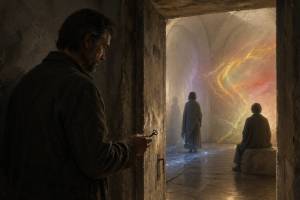
The Keeper of the Room
The door is easy to miss— a dim recess, knotted and coarse. He kept the room for a long time— some places are made of wood and plaster— this one is made of whatever people bring inside. People pass it every day already elsewhere. If you ask, he gives you the key. Not ceremoniously— just a small warmth from others who came before. The lock turns easily as though expecting them, and the two friends enter. To the first, the room offers nothing— white walls, corners meet in muted shadows, light without direction. She […]
Read More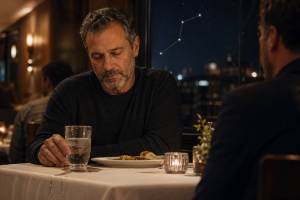
The Threshold of Truth
When you meet someone new, it’s the heat that won’t break, the dry cleaner down the street that’s too expensive, how you take your coffee. We sat over dinner. He sent the dish back— too spicy, he said, as if it were the dish that missed the mark. They brought something softer. He thanked them, moved on. So did I. The questions came in their usual spacing— easy enough to keep things level. He asks it and reaches for his glass before I answer. How many children? I feel the ice in my […]
Read More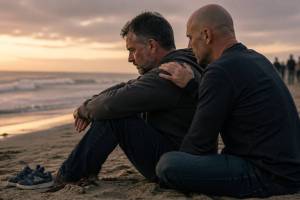
A CROWD IS THE WRONG PLACE FOR A WHISPER
A crowd is the wrong place for a whisper. Sound there is measured in weight, not meaning. A whisper asks something else. For proximity. For stillness. For the small kindness of someone leaning in, of meeting a mild breeze. It does not compete. It waits. It listens for the quiet of a wave braking at ocean’s edge. In a crowd, it is mistaken for absence. But in the dark, when one person turns and another is already listening, it becomes a bridge— not loud enough to impress, only strong enough to cross. POEM GUIDE AND […]
Read More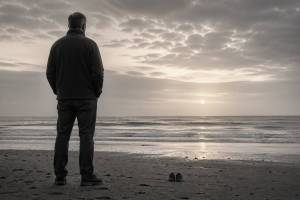
BETWEEN TWO GRAVITIES
Most mornings, the sun rises in grayscale, weighted between two gravities. I fasten the mask again— it’s thin, too thin— hoping it veils what flickers beneath. I’m tired of being praised for holding it together— as though silence is sainthood, as though endurance is free. I wonder, if the colors I see are the same as yours. Is my red the burn of a star too near, my blue a trench that swallows light? Are both tethered by forces I can’t unlearn, by concepts I have no words for? You see a calm ocean; I see depths […]
Read More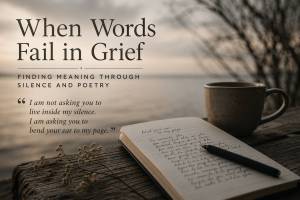
The Poem Was The Meaning
After my son died, I did not lose the ability to speak. I could answer questions, describe what had happened, and walk someone through the sequence of events in a way that sounded complete. I could even say it plainly: I got a call from a stranger, three thousand miles away, telling me my son was dead. I sat in my office chair, frozen. That is not something I’ll forget. On the surface, nothing was wrong with my language. Words still worked for logistics—phone calls, explanations, the details people needed. I could confirm, clarify, repeat. But when it came to […]
Read More
Open to Hope is an online community offering inspirational stories of loss, hope and recovery. We believe hope is the bridge between loss and recovery.


